Thursday, July 20, 2017
Thursday Thought of the Day
Why do you think people are more likely to trust word of mouth rather than ads on Television?

Wednesday, July 19, 2017
Wisdom Wednesdays-Kofi Annan
"Knowledge is power. Information is liberating. Education is the premise of progress, in every society, in every family."-Kofi Annan
Tuesday, July 18, 2017
Teaching Tuesdays-Punctuation Matters!
Punctuation
These OWL resources will help you with punctuation, such as using commas, quotation marks, apostrophes, and hyphens.
Punctuation
When speaking, we can pause or change the tone of our voices to indicate emphasis. When writing, we must use punctuation to indicate these places of emphasis. This resource should help to clarify when and how to use various marks of punctuation.
Sentence Punctuation Patterns
This handout describes eight sentence punctuation patterns with examples.
Independent and Dependent Clauses
This handout defines dependent and independent clauses and explores how they are treated in standard usage.
Conquering the Comma
This presentation is designed to acquaint your students with the rules of comma usage, including placement in compound sentences, after introductory elements, with dependent phrases and clauses, around nonessential elements, in a series, and with adjectives. This presentation will also cover methods for avoiding a common comma error—the comma splice. The thirty-one slide presentation included here is designed to aid the facilitator in an interactive presentation of the elements of comma usage. This presentation is ideal for the beginning of a composition course, the assignment of a writing project, or as a refresher presentation for grammar usage.
Commas
This resource offers a number of pages about comma use.
Apostrophe
This handout provides rules and examples for apostrophe usage.
Hyphens
A comprehensive rundown on the proper use of the hyphen.
Quotation Marks
A rundown of the general rules of when and where to use quotation marks.
Monday, July 17, 2017
Math Mondays:Fractions
Reducing Fractions
Purplemath
In what follows, it will sometimes be useful to remember that fractions can indicate division. For instance, 1/3 can mean "one divided by three", as well as "one part out of three parts". In fact, let's cut to the chase; memorize this sentence: "Fractions are division."
For instance, here's how you would find and use a form of 1 to reduce 4/8:
To be very clear, the point of finding the common factor (in this case, the 4's) is to allow you to convert part of the fraction to 1. Since 4/4 = 1, then what I did above was the following:

Warning: Note how I switched from a fraction with products (in the numerator and denominator):
...to a product of fractions:
This switch is okay as long as you're multiplying:
...but it is very much NOT if you're adding. For instance:
The left-hand side above, being a fraction containing addition, is equal to 5/6, while the right-hand side above, being an addition containing fractions, is equal to 1 1/2, so the two expressions are not at all the same value. Just remember: For fractions, multiplying is way easier than adding. Now, to get back to business...
In addition to the canceling method I used above (with the pink 1's), you may also have seen either of the following "shorthands" for cancellation:


Any of these formats is fine. The last two are probably simplest for your handwritten homework; the first one is easier for typesetting.
If you have a regular (scientific, business, etc.) calculator that can handle fractions, then you can enter the fraction and then hit the "equals" button to get the reduced fraction. If you have a graphing calculator with a fraction command, then you can enter the fraction as a division (because 4/8 means "four divided by eight"), and then convert to fraction form. Check your manual.
If your calculator can't handle fractions, or if the denominator is too large for the calculator to handle, here's how you do the reduction by hand.
Reduce to simplest form.
I'll grab my calculator and some scrap paper, and factor the numerator (top number) and denominator (bottom number). A quick shorthand for getting the prime factorization of each of these numbers is demonstrated below, in the stacked division (by prime numbers) of 2940:
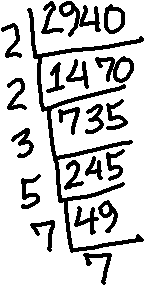
To find the factorization, I just read off the prime factors from around the outside of the upside-down division. From the above, I can see that 2940 factors as 2×2×3×5×7×7.

Next, I'll factor the denominator, being the number 3150:
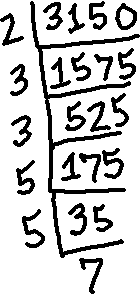
So 3150 factors as 2×3×3×5×5×7.
Now I can reduce the fraction by canceling off the common factors:

The next section reviews mixed numbers and improper (or "vulgar") fractions....http://www.purplemath.com/modules/fraction.htm
Friday, July 14, 2017
Financial Fridays-Balancing a Checkbook
http://financeintheclassroom.org/downloads/CheckingUnitLessonPlans.pdf
Click on the link to learn how to balance a checkbook! After reading through the content, practice the problems.
Click on the link to learn how to balance a checkbook! After reading through the content, practice the problems.
Thursday, July 13, 2017
Thursday Thoughts: What makes a person sucessful?
Success can be defined in a variety of ways: through work, school, or family but what makes an individual successful?
Wednesday, July 12, 2017

Subscribe to:
Posts (Atom)