http://financeintheclassroom.org/downloads/CheckingUnitLessonPlans.pdf
Click on the link to learn how to balance a checkbook! After reading through the content, practice the problems.
Friday, July 14, 2017

Thursday, July 13, 2017
Thursday Thoughts: What makes a person sucessful?
Success can be defined in a variety of ways: through work, school, or family but what makes an individual successful?
Wednesday, July 12, 2017

Tuesday, July 11, 2017
Teaching Tuesdays: How to Quote
Extended Rules for Using Quotation Marks
Summary:
A rundown of the general rules of when and where to use quotation marks.
Contributors:Sean M. Conrey, Mark Pepper, Allen Brizee
Last Edited: 2010-04-17 06:03:37
Last Edited: 2010-04-17 06:03:37
Altering the Source Material in a Quotation
The responsibility of representing other people's words accurately lies firmly on the shoulders of the author. Inaccurate quotes not only defeat the purpose of using a quote, they may also constitute plagiarism. However, there are approved methods for altering quotes for either clarity or succinctness.
Quote length
If the original quote is too long and you feel not all the words are necessary in your own paper, you may omit part of the quote. Replace the missing words with an ellipsis.
Original Quote: The quarterback told the reporter, "It's quite simple. They played a better game, scored more points, and that's why we lost."
Omitted Material: The quarterback told the reporter, "It's quite simple. They . . . scored more points, and that's why we lost."
Make sure that the words you remove do not alter the basic meaning of the original quote in any way. Also ensure that the quote's integration and missing material still leave a grammatically correct sentence.
Quote context
If the context of your quote might be unclear, you may add a few words to provide clarity. Enclose the added material in brackets.
Added Material: The quarterback told the reporter, "It's quite simple. They [the other team] played a better game, scored more points, and that's why we lost."
Quotations within a Quotation
Use single quotation marks to enclose quotes within another quotation.
The reporter told me, "When I interviewed the quarterback, he said they simply 'played a better game.'"
Quotation Marks Beyond Quoting
Quotation marks may additionally be used to indicate words used ironically or with some reservation.
The great march of "progress" has left millions impoverished and hungry.
Do not use quotation marks for words used as words themselves. In this case, you should use italics.
The English word nuance comes from a Middle French word meaning "shades of color."https://owl.english.purdue.edu/owl/resource/577/02/
Monday, July 10, 2017
Math Monday-Factoring Numbers
Factoring Numbers
Purplemath
"Factors" are the numbers you multiply to get another number. For instance, factors of 15 are 3 and 5, because 3×5 = 15. Some numbers have more than one factorization (more than one way of being factored). For instance, 12 can be factored as 1×12, 2×6, or 3×4. A number that can only be factored as 1 times itself is called "prime". The first few primes are 2, 3, 5, 7, 11, and 13. The number 1 is not regarded as a prime, and is usually not included in factorizations, because 1 goes into everything. (The number 1 is a bit boring in this context, so it gets ignored.)
You most often want to find the "prime factorization" of a number: the list of all the prime-number factors of a given number. The prime factorization does not include 1, but does include every copy of every prime factor. For instance, the prime factorization of 8 is 2×2×2, not just "2". Yes, 2 is the only factor, but you need three copies of it to multiply back to 8, so the prime factorization includes all three copies.
On the other hand, the prime factorization includes ONLY the prime factors, not any products of those factors. For instance, even though 2×2 = 4, and even though 4 is a divisor of 8, 4 is NOT in the PRIME factorization of 8. That is because 8 does NOT equal 2×2×2×4! This accidental over-duplication of factors is another reason why the prime factorization is often best: it avoids counting any factor too many times. Suppose that you need to find the prime factorization of 24. Sometimes a student will just list all the divisors of 24: 1, 2, 3, 4, 6, 8, 12, and 24. Then the student will do something like make the product of all these divisors: 1×2×3×4×6×8×12×24. But this equals 331776, not 24. So it's best to stick to the prime factorization, even if the problem doesn't require it, in order to avoid either omitting a factor or else over-duplicating one.
In the case of 24, you can find the prime factorization by taking 24 and dividing it by the smallest prime number that goes into 24: 24 ÷ 2 = 12. (Actually, the "smallest" part is not as important as the "prime" part; the "smallest" part is mostly to make your work easier, because dividing by smaller numbers is simpler.) Now divide out the smallest number that goes into 12: 12 ÷ 2 = 6. Now divide out the smallest number that goes into 6: 6 ÷ 2 = 3. Since 3 is prime, you're done factoring, and the prime factorization is 2×2×2×3.
An easy way of keeping track of the factorization is to do upside-down division. It looks like this:

The nice thing about this upside-down division is that, when you're done, the prime factorization is the product of all the numbers around the outside. The factors are circled in red above. By the way, this upside-down division is something that should probably be done on scratch-paper, and not handed in as part of your homework.
Find the prime factorization of 1050.
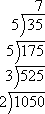
I'll do the upside-down division:

Then my answer is: 1050 = 2 × 3 × 5 × 5 × 7
Some texts prefer that answers such as this be written using exponential notation, in which case the final answer would be written as 2×3×52×7.
You can do the repeated division "right-side up", too, if you prefer. The process works the same way, but the division is reversed in orientation. The above problem would be worked out like this:
Find the prime factorization of 1092.
I'll do the repeated division:
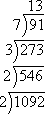
1092 = 2 × 2 × 3 × 7 × 13
This answer might also be written as 22×3×7×13.
By the way, there are some divisibility rules that can help you find the numbers to divide by. There are many divisibility rules, but the simplest to use are these:
If the number is even, then it's divisible by 2.
If the number's digits sum to a number that's divisible by 3, then the number itself is divisible by 3.
If the number ends with a 0 or a 5, then it's divisible by 5.
Of course, if the number is divisible twice by 2, then it's divisible by 4; if it's divisible by 2 and by 3, then it's divisible by 6; and if it's divisible twice by 3 (or if the sum of the digits is divisible by 9), then it's divisible by 9. But since you're finding the prime factorization, you don't really care about these non-prime divisibility rules. There is a rule for divisibility by 7, but it's complicated enough that it's probably easier to just do the division on your calculator and see if it comes out even.
If you run out of small primes and you're not done factoring, then keep trying bigger and bigger primes (11, 13, 17, 19, 23, etc) until you find something that works – or until you reach primes whose squares are bigger than what you're dividing into. Why? If your prime doesn't divide in, then the only potential divisors are bigger primes. Since the square of your prime is bigger than the number, then a bigger prime must have as its remainder a smaller number than your prime. The only smaller number left, since all the smaller primes have been eliminated, is 1. So the number left must be prime, and you're done.
Friday, July 7, 2017

Thursday, July 6, 2017
Subscribe to:
Posts (Atom)